

Solar Panel Angle Guide: Maximize Energy Efficiency with the Optimal Tilt
LIWEN HUA
The angle at which you install your solar panels directly impacts how much electricity they generate. Getting this right means the difference between a system that meets 70% of your energy needs versus one that falls short of expectations. This comprehensive guide explains exactly how to calculate the perfect tilt for your location, why orientation matters, and what factors affect your panel efficiency throughout the year.
Why Solar Panel Angle Matters for Maximum Efficiency
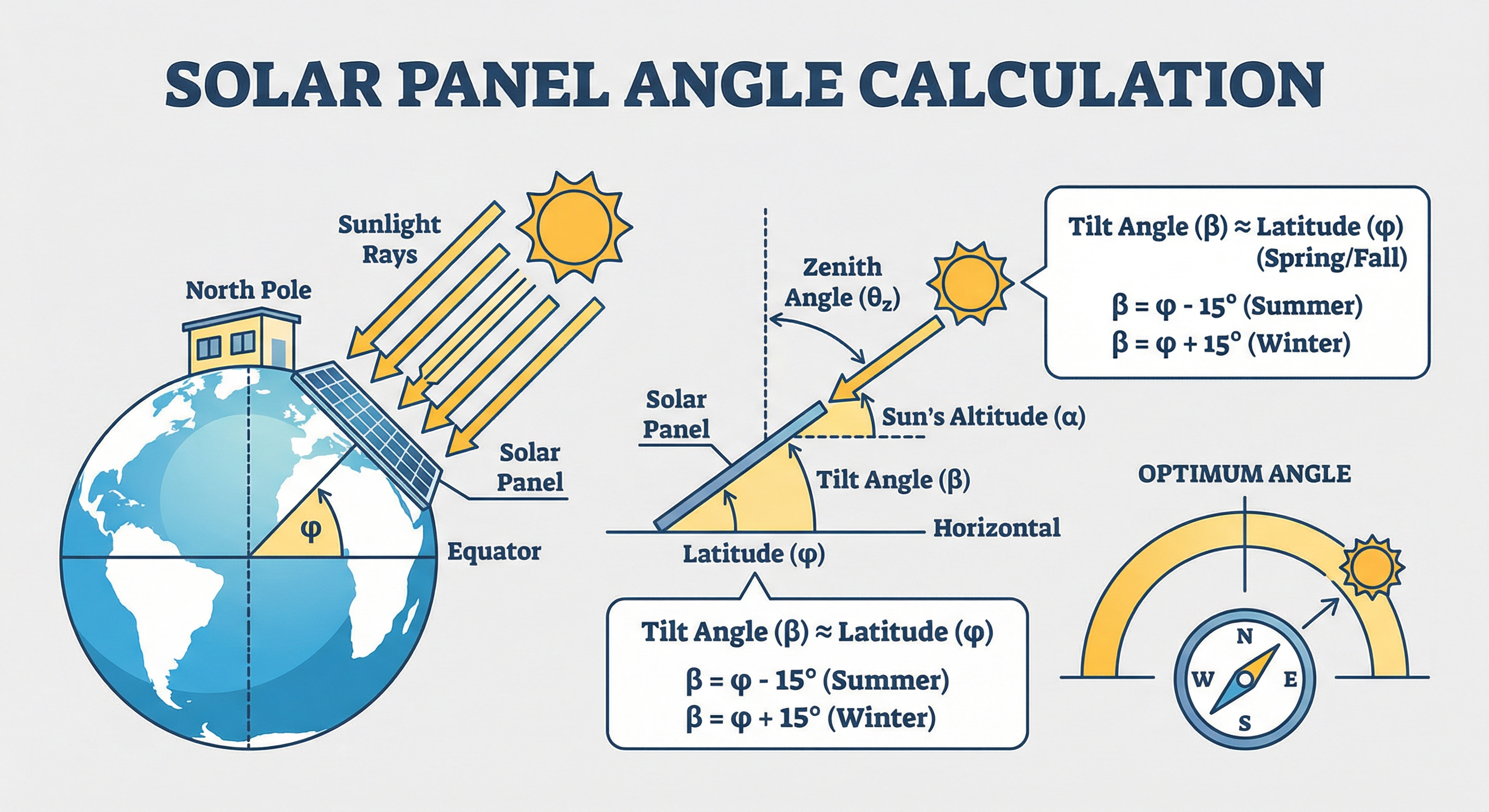
Solar panel angle refers to the vertical tilt of your panels relative to the horizontal ground surface. This tilt angle determines how directly sunlight strikes your panel surface, which directly correlates to electricity production. When sunlight hits panels perpendicularly—at a 90-degree angle—your system captures the maximum possible energy. Any deviation from this optimal position reduces efficiency.
The sun's position in the sky changes based on two key factors: your geographical location (latitude) and the time of year (season). Cities near the equator, such as Brownsville or El Paso, require less tilt because the sun sits higher in the sky year-round. Conversely, cities further from the equator like Chicago or Denver need steeper angles to catch the lower winter sun. Understanding this relationship between your location and optimal tilt helps you extract the most power from your investment.
Research indicates that solar panels can lose 1-1.5% efficiency when angled just 10-15 degrees from the optimal tilt. For a typical residential system producing 10,000 kWh annually, that difference could mean losing 100-150 kWh of free electricity every year. Over the 25-30 year lifespan of your solar array, these losses compound significantly, making correct initial installation crucial for long-term returns.
Understanding the Difference Between Angle and Orientation
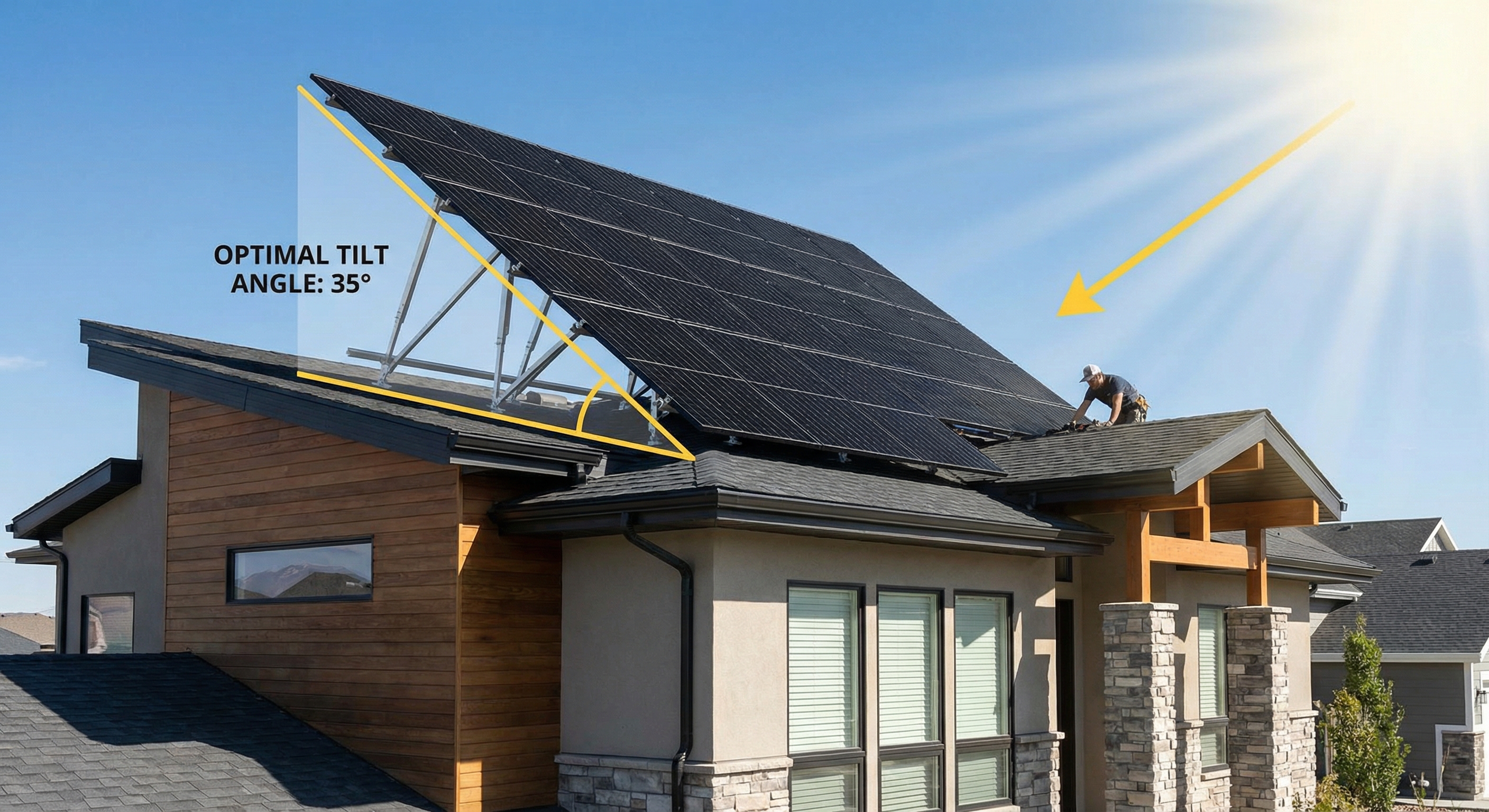
Many homeowners confuse panel angle with panel orientation, but these are two distinct factors that both impact system performance. Panel angle describes the vertical tilt—how much your panels lean backward from a flat position. Panel orientation describes the horizontal direction your panels face, whether toward true south, east, west, or north. Both must be optimized for maximum energy production.
In the Northern Hemisphere, solar panels should face true south (not magnetic south, which differs based on your location). In the Southern Hemisphere, panels face true north. This orientation ensures your system receives sunlight for the longest possible duration each day. Installing panels facing the wrong direction—even with perfect angle—severely limits morning and afternoon production when electricity demand typically peaks.
Professional installers use true direction readings based on Earth's geographical axis rather than magnetic compass readings. Magnetic poles can deviate significantly from true poles—sometimes by 10-20 degrees depending on your location. Failing to account for this difference means your "south-facing" panels might actually face southeast or southwest, reducing optimal exposure during peak production hours.
How to Calculate Your Optimal Solar Panel Angle
The Simple Calculation Method
The easiest way to determine your optimal tilt uses a straightforward formula based on your latitude. For winter months when the sun sits lower in the sky, add 15 degrees to your latitude. For summer months when the sun rides higher, subtract 15 degrees from your latitude. This seasonal adjustment maximizes capture during each period's peak sun position.
For example, if your latitude is 30 degrees: winter optimal angle equals 30° + 15° = 45°, while summer optimal angle equals 30° - 15° = 15°. This simple method provides a practical starting point for most installations and works well for fixed-position panels that don't move throughout the year.
The seasonal approach works best if you're willing to adjust your panel angle twice yearly—once in spring and once in autumn. Many homeowners find this minor maintenance worthwhile given the 5-10% efficiency gains compared to using a fixed year-round angle.
The More Precise Calculation Method
For greater accuracy, solar professionals use more detailed formulas that account for the sun's actual declination angle throughout the year. For winter, multiply your latitude by 0.9, then add 29 degrees. For summer, multiply latitude by 0.9 and subtract 23.5 degrees.
Using the same 30-degree latitude example: winter angle equals (30 × 0.9) + 29° = 56°, while summer angle equals (30 × 0.9) - 23.5° = 3.5°. This method produces steeper winter angles than the simple formula because it accounts for the sun's position during winter solstice when daylight hours are shortest.
The more precise method reveals that many "rule of thumb" recommendations actually undershoot optimal winter angles, particularly in northern regions. Homeowners in latitudes above 40 degrees may find their winter optimal angles exceed 60 degrees—much steeper than the commonly suggested 45-degree angle.
Optimal Solar Panel Angles for Major US Cities
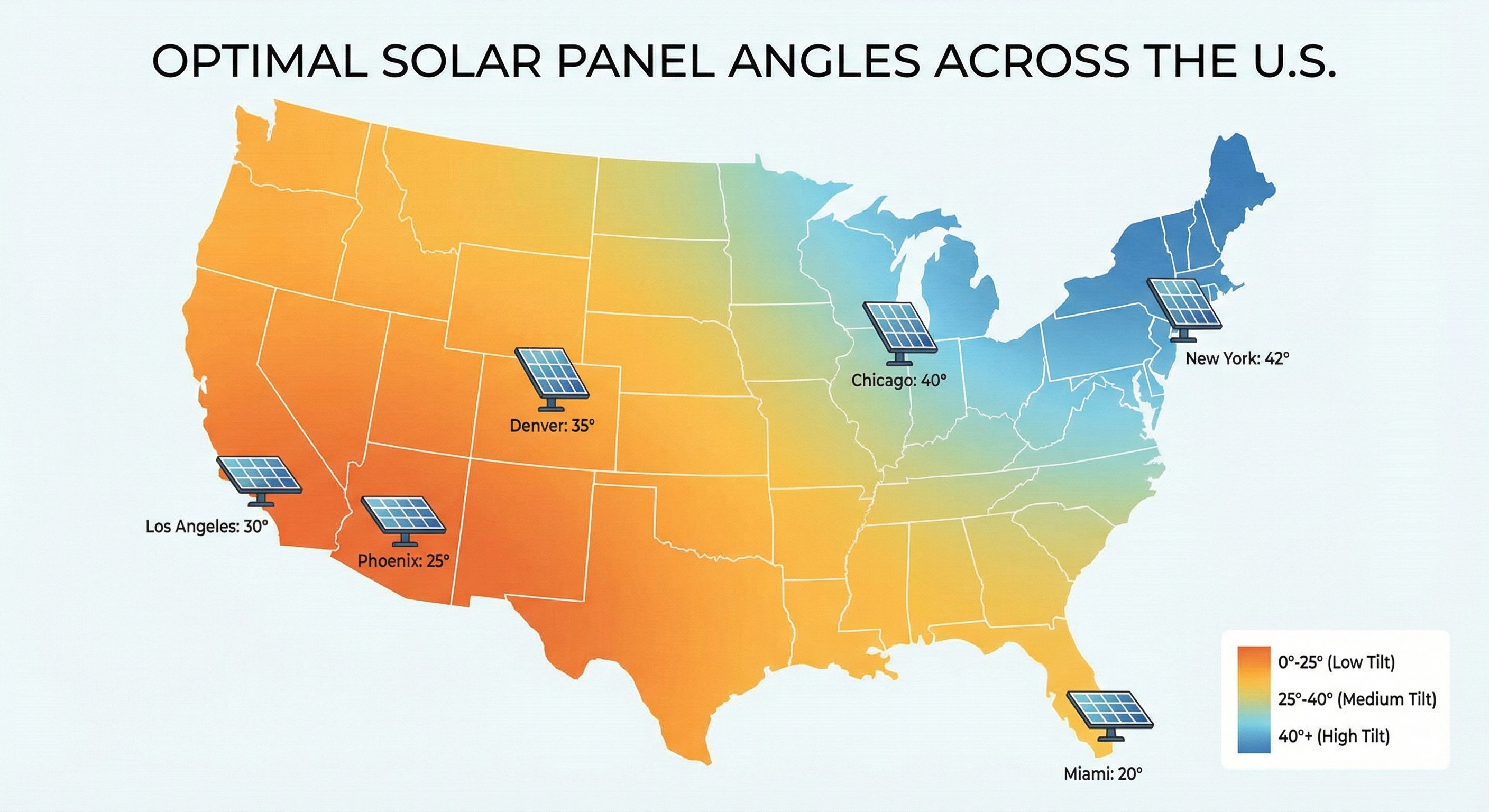
Different cities require different tilt angles based on their geographic latitude and typical weather patterns. Below are the recommended angles for major US metropolitan areas, broken down by season and year-round optimal positioning.
| City | Year-Round Angle | Summer Angle | Winter Angle |
|---|---|---|---|
| New York City | 31.9° | 16.9° | 46.9° |
| Los Angeles | 28.7° | 13.7° | 43.7° |
| Chicago | 32.3° | 17.3° | 47.3° |
| Houston | 29.6° | 14.6° | 44.6° |
| Phoenix | 33.4° | 18.4° | 48.4° |
| San Diego | 32.7° | 17.7° | 47.7° |
| Washington D.C. | 38.9° | 23.9° | 53.9° |
These figures represent starting points for your specific installation. Local factors such as roof pitch, shading from trees or buildings, and local climate patterns can shift the ideal angle slightly. Professional installers typically use solar path calculators that account for these variables when designing your system.
For year-round fixed installations that cannot be adjusted seasonally, aim for your latitude minus 10-15 degrees. This provides a good balance between summer and winter production without requiring manual adjustment. In practice, most US homeowners find optimal results with fixed angles between 30-45 degrees.
Key Factors That Affect Your Ideal Solar Panel Angle
Geographic Latitude
Your latitude is the primary determinant of optimal tilt angle. The farther your location from the equator, the steeper your required angle to compensate for the sun's lower position in the sky. In the continental United States, optimal angles range from approximately 25 degrees in southern Florida to over 50 degrees in northern Minnesota.
Latitude affects not just the optimal angle but also the seasonal variation you should account for. Northern locations experience greater differences between summer and winter sun positions, meaning adjustable tilt systems provide more benefit in higher latitudes than in southern regions where the sun's path varies less dramatically throughout the year.
Seasonal Sun Position
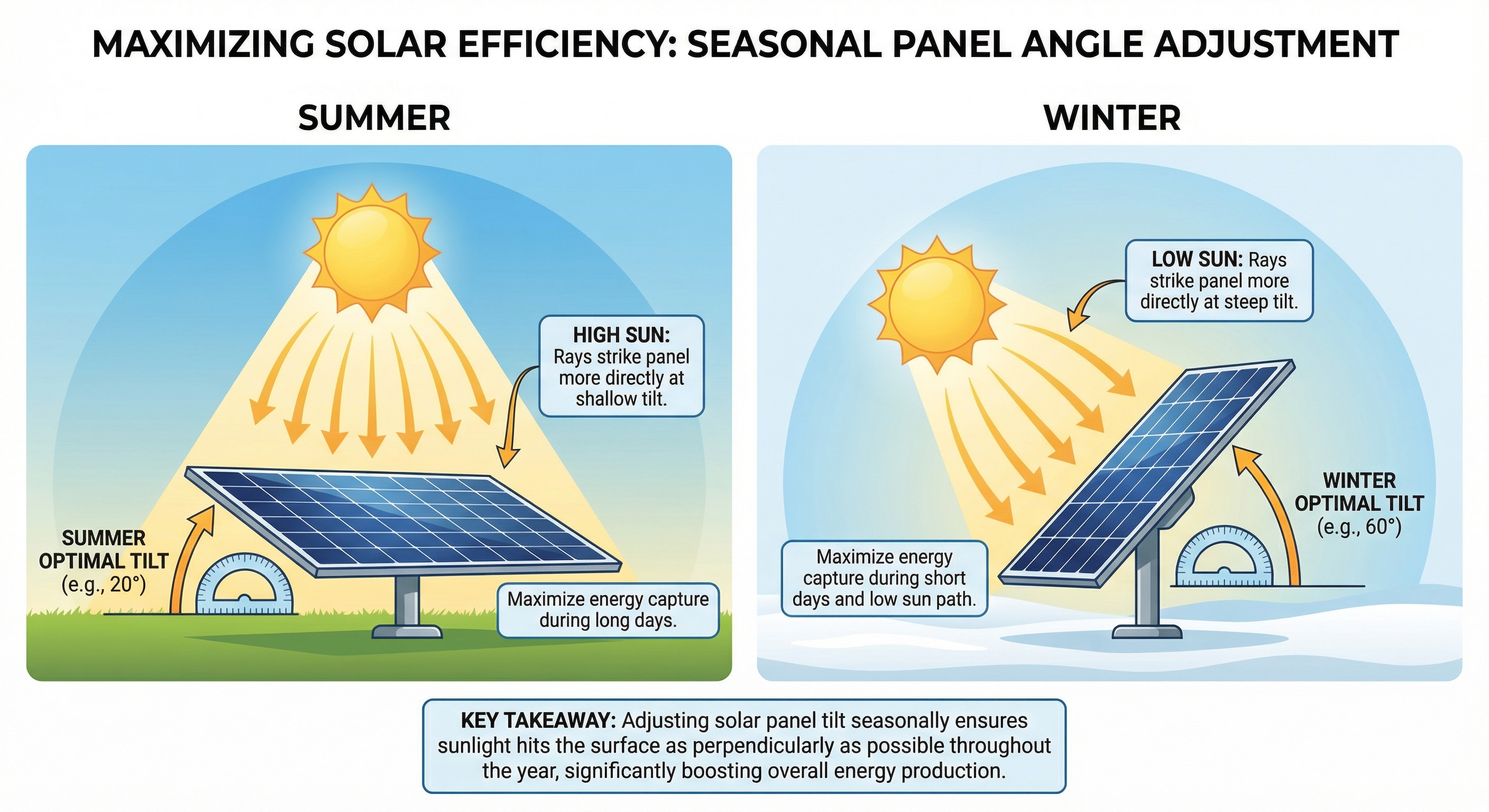
The Earth tilts on its axis at 23.5 degrees, causing the sun's apparent position to shift significantly between summer and winter. During summer solstice, the sun reaches its highest point—accounting for longer days and more intense sunlight. During winter solstice, the sun sits lowest, producing shorter days with less intense energy reaching your panels.
This seasonal variation explains why adjustable mounting systems prove valuable. Moving panels from a 15-degree summer angle to a 45-degree winter angle can boost winter production by 20-30% in northern latitudes compared to maintaining a fixed year-round position. The additional energy captured often justifies the extra installation complexity and occasional adjustment effort.
Roof Design and Structure
Your roof's design significantly impacts achievable panel angle. Flat roofs offer maximum flexibility—you can mount panels at any angle using tilted racking systems. Steeper roofs may require panels to lay flush with the roof surface, limiting your angle options to whatever matches your roof pitch.
For flat-roof installations, adding 10-15 degrees of tilt using specialized racking provides much better performance than laying panels flat. Even small tilts dramatically reduce dust and debris accumulation while improving panel self-cleaning during rainfall. Most flat-roof installations use 10-30 degree tilt angles depending on aesthetic considerations and wind load requirements.
If your roof has an unusual pitch or orientation, ground-mounted systems offer an alternative that allows perfect angle optimization. Ground mounts cost more upfront but provide easier access for cleaning and maintenance while achieving optimal production regardless of your roof's limitations.
Solar Trackers: Automatic Angle Optimization
Types of Tracking Systems
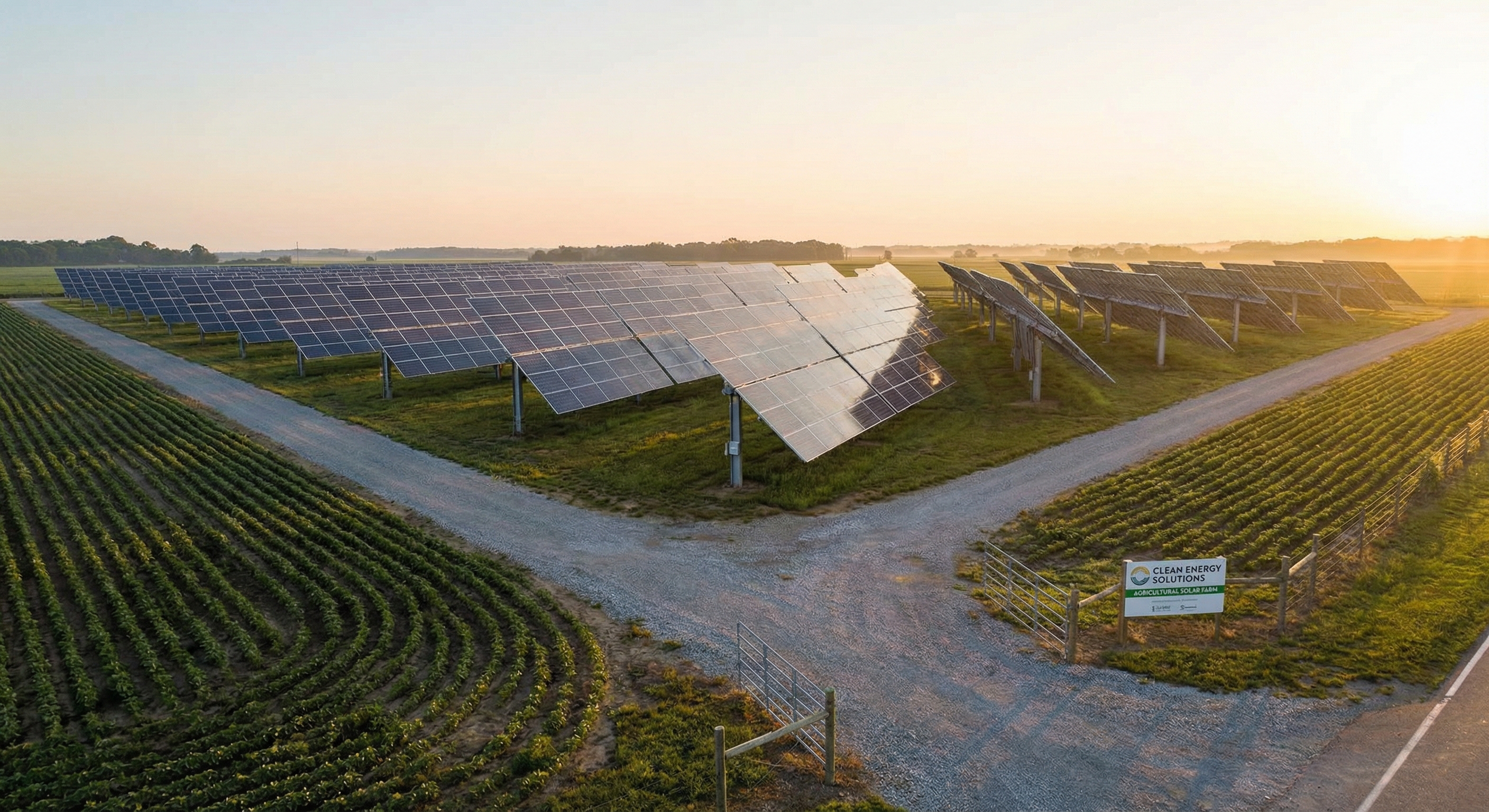
Solar trackers automatically adjust panel angle throughout the day to maintain perpendicular sunlight exposure. Single-axis trackers move panels back and forth in one direction—typically following the sun from east to west across the sky. These systems can increase energy production by 25-35% compared to fixed installations.
Dual-axis trackers add a second movement that adjusts for seasonal sun position changes in addition to daily east-west travel. These systems can boost production by up to 40% over fixed arrays, making them attractive for homeowners seeking maximum energy independence despite higher costs and complexity.
Common single-axis configurations include polar trackers (which rotate on an axis angled to match the local latitude), horizontal trackers (rotating around a horizontal axis), and vertical trackers (rotating around a vertical axis while tilting). Each type suits different geographic locations and roof configurations.
Benefits and Drawbacks of Tracking Systems
The primary benefit of tracking systems is maximized energy production throughout the day and year. Instead of capturing peak sunlight only during midday hours, tracked panels follow the sun from sunrise to sunset, maintaining near-optimal exposure continuously. For homeowners with limited roof space, tracking can effectively increase system capacity without adding panels.
However, tracking systems come with significant drawbacks. Mechanical complexity increases failure points—motors, gears, and control systems can malfunction. Maintenance requirements exceed fixed installations, and repair costs are substantially higher. Additionally, trackers add 10-20% to total system costs while requiring more robust mounting structures to handle moving components.
Most residential solar installations remain fixed-position for cost and reliability reasons. The incremental production gain from tracking often doesn't justify the added expense and potential maintenance headaches, especially when panel prices continue falling—adding more fixed panels usually provides better return on investment than adding tracking to fewer panels.
Frequently Asked Questions About Solar Panel Angles
At What Angle Do Solar Panels Lose Efficiency?
Solar panels begin losing measurable efficiency when tilted more than 10-15 degrees away from optimal angle. At this deviation, you can expect efficiency losses of 1-1.5%. Greater deviations compound these losses—panels tilted 30 degrees from optimal may lose 5% or more efficiency compared to properly angled installations.
The exact loss varies based on your latitude and the time of year. In summer when the sun sits higher, the tolerance for angle error is slightly greater. Winter installations require more precision because the lower sun angle means any deviation creates a larger difference between actual and optimal incidence angles.
What Is the Best Angle for Solar Panels in the United States?
For most US locations, the ideal fixed angle falls between 30-45 degrees, with 35 degrees being a practical middle ground for year-round production. Panels should face true south (not magnetic south) for maximum daily exposure. This general guideline works across most of the continental United States, though specific locations benefit from slight adjustments.
The variation across US cities—from 28.7 degrees in Los Angeles to nearly 40 degrees in Washington D.C.—reflects the significant latitude range across the country. Coastal areas with frequent fog may benefit from slightly steeper angles to improve panel exposure above cloud layers, while clear southwestern locations can often use shallower tilts.
Why Do Solar Panels Work Best at an Angle?
Angled panels work better because they can face the sun directly throughout the day. When sunlight strikes perpendicularly—coming straight at the panel surface rather than at an angle—more photons penetrate the semiconductor material to generate electricity. Flat panels miss significant energy because sunlight arrives at shallow angles during morning and evening hours.
The angle also affects panel self-cleaning. Tilted panels allow rain to wash away dust and debris more effectively than flat surfaces where water pools. In dry, dusty climates, this cleaning effect can provide meaningful production gains beyond pure angle optimization.
Conclusion: Optimizing Your Solar Panel Angle for Maximum Returns
Getting your solar panel angle right delivers immediate, tangible benefits in increased energy production without additional equipment costs. Whether you choose a fixed installation at 30-45 degrees or invest in an adjustable system, understanding the principles behind optimal tilt helps you make informed decisions about your solar investment.
For most homeowners, a fixed angle matching your latitude (or slightly less) provides the best balance of cost, complexity, and production. If your roof limits angle options, consider ground mounting or working with an installer who can recommend tilt solutions that overcome structural constraints. The small additional investment in proper angle optimization pays dividends throughout your system's operational life.
Ready to optimize your solar installation? Calculate your latitude using online tools, compare your current panel angle against the recommendations in this guide, and consult with professional installers about adjustable mounting options if your production falls short of expectations. Every degree of optimization adds up to cleaner energy and greater savings over time.