

The Journey Continues: Your Complete Guide to Portable Solar Power Solutions
xuyangquan
The world is changing. Forty percent of the global population now experiences power outages annually, and outdoor recreation participation has surged by 18% since 2020. Meanwhile, solar panel costs have dropped 89% in the last decade, making clean energy more accessible than ever. If you've ever been stranded without power during a camping trip or lost electricity during a storm, you understand why portable solar power systems have become essential equipment for modern adventurers and preparedness-minded households alike.
This guide is your comprehensive resource for understanding portable power stations and solar panels—how they work, which scenarios they serve best, how to choose the right system, and what innovations will shape the industry through 2030 and beyond.
Understanding Portable Solar Power Systems
What Is a Portable Power Station?
A portable power station is a rechargeable battery-based power source that stores electricity for later use. Unlike traditional gas generators, these devices produce zero emissions, operate silently, and can be recharged via solar panels, wall outlets, or vehicle charging ports.
Key components include:
- Lithium-ion or LiFePO4 battery cells — Store DC electricity safely
- Built-in inverter — Convert DC to AC power for standard devices
- Multiple output ports — USB-A, USB-C, AC outlets, 12V car ports
- Charge controller — Regulate incoming power to prevent overcharging
- Battery management system (BMS) — Protects against short circuits, overheating, and voltage fluctuations
According to the International Energy Agency (IEA), global energy storage capacity must increase by a factor of 10 to meet 2030 climate targets, with portable systems playing a significant role in distributed energy adoption.
How Portable Solar Panels Work
Portable solar panels harness the photovoltaic effect to generate electricity from sunlight. When photons strike semiconductor materials (typically silicon), they dislodge electrons, creating an electrical current.
The energy flow follows this path:
1.Solar irradiation hits the panel's photovoltaic cells
2.Direct current (DC) electricity is generated
3.Charge controller regulates voltage and current
4.Battery storage receives and holds the charge
5.Inverter converts stored DC to usable AC power
6.Devices receive power through various output ports
Modern portable panels achieve 22-25% conversion efficiency, meaning nearly one-quarter of sunlight captured becomes usable electricity. The National Renewable Energy Laboratory (NREL) reports that solar panel efficiency has improved by approximately 0.5% annually over the past decade.
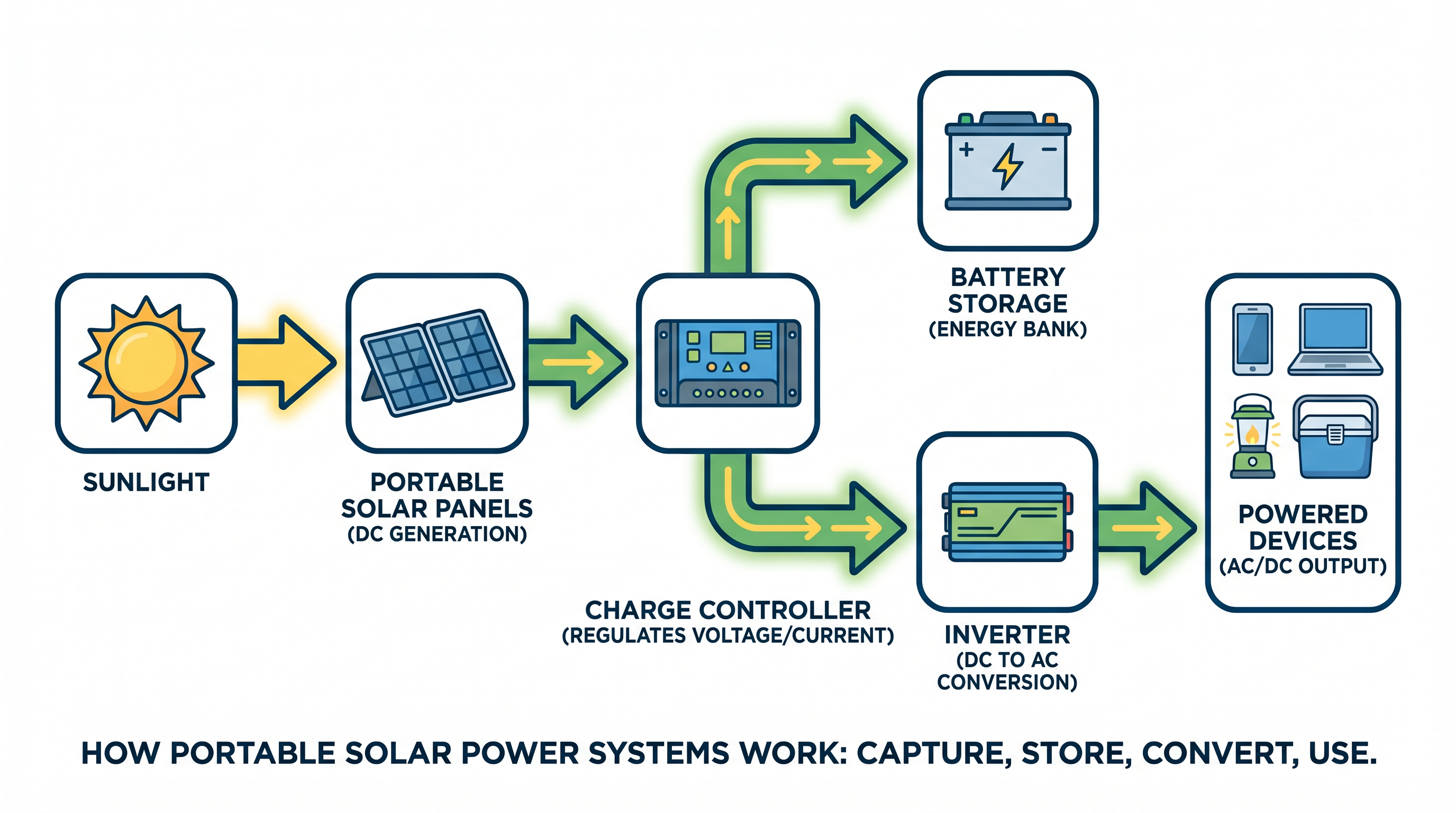
How portable solar power system works diagram
Why Portable Solar Power Matters Now
Environmental Benefits
Portable solar power systems produce clean, renewable energy without fuel consumption, noise pollution, or harmful emissions. A typical 200W portable solar panel setup can offset approximately 1,500 pounds of carbon dioxide annually—equivalent to planting 25 trees.
The EPA estimates that if just 5% of American households adopted solar-powered backup systems, the collective carbon reduction would equal removing 2.3 million cars from the road.
Economic Advantages
While initial investment costs exist, portable solar systems deliver long-term savings. The average American household spends $150-200 monthly on electricity. A quality portable power station paired with solar panels can reduce grid dependency and provide decades of free renewable energy after the upfront purchase.
Energy Independence
From remote work requirements to increasing extreme weather events, grid reliability cannot be guaranteed. Portable solar power provides autonomy—power that travels with you, works during outages, and never depends on distant infrastructure.
Primary Use Cases for Portable Power Stations
1. Camping and Outdoor Recreation
Portable power stations have transformed outdoor experiences. Modern campers use them to:
- Charge smartphones, tablets, and laptops
- Power portable refrigerators and coolers
- Run LED lighting systems
- Operate CPAP machines overnight
- Charge camera batteries and drone batteries
- Power electric blankets or small heaters
Real-world example: A weekend camping trip with a 1000Wh portable power station can keep a smartphone charged 30+ times, a mini-fridge running for 24 hours, and provide lighting for 50+ hours—comfortably supporting a family of four without sacrificing modern conveniences.

Family camping with portable power station
2. Emergency Backup Power
Natural disasters increasingly disrupt power grids. Hurricanes, winter storms, and wildfires cause outages lasting hours to weeks. Portable solar systems provide:
- Life-critical device charging (phones, medical equipment)
- Emergency communication capability
- Refrigeration for medications and food
- Lighting and heating during emergencies
- Information access when traditional power fails
Statistics: FEMA reports that 60% of Americans have experienced a power outage lasting more than 24 hours in the past two years. Only 42% have an emergency power plan. Portable solar bridges this gap affordably.
3. Remote Work and Digital Nomad Lifestyle
The rise of location-independent work has created demand for reliable off-grid power. Remote workers use portable systems to:
- Power laptops and monitors
- Maintain stable internet via routers and modems
- Charge multiple devices simultaneously
- Operate in locations without grid access
- Reduce reliance on coffee shops and coworking spaces
4. Tailgating and Outdoor Events
Portable power stations eliminate the need for long extension cords or idling vehicle power. They cleanly power:
- Bluetooth speakers
- Portable TVs and projectors
- Electric grills and cooking equipment
- Lighting setups
- Gaming consoles
5. Off-Grid Living and Van Life
Full-time van dwellers and minimalists increasingly rely on portable solar as their primary power source. A well-designed 2000Wh system with 400W of solar panels can support:
- Refrigeration
- Laptop and device charging
- Water pumps
- Ventilation fans
- Occasional microwave use
How to Choose the Right Portable Power Station
Battery Capacity: Watt-Hours (Wh)
Battery capacity, measured in watt-hours (Wh), indicates how much energy a unit can store.
| Capacity Range | Best For | Example Devices Powered |
|---|---|---|
| 200-500Wh | Day trips, phone charging, small devices | Smartphones (50+ charges), tablets (10+ charges), LED lights |
| 500-1000Wh | Weekend camping, emergency backup | Mini-fridges (12 hours), laptops (8-10 charges), CPAP machines |
| 1000-2000Wh | Extended trips, partial home backup | Full-size refrigerators (16+ hours), power tools, TV (8+ hours) |
| 2000Wh+ | Whole-home backup, professional use | Multiple large appliances, extended off-grid living |
Rule of thumb: Calculate your total daily watt-hour consumption, then multiply by the number of days you want backup power for. Add 20% buffer for inefficiency and unexpected needs.
Power Output: Wattage (W)
Rated continuous wattage determines what devices you can simultaneously power. Peak/surge wattage indicates the brief burst capacity needed to start motors (like refrigerators).
- 100-300W: Phones, tablets, laptops, small fans, LED lights
- 500-1000W: Medium appliances, power tools, small space heaters
- 1000-2000W: Major appliances, multiple devices, coffee makers, microwaves
- 2000W+: Heavy-duty equipment, air conditioners, welders
Important: Never exceed the unit's continuous wattage rating, even for short periods.
Battery Chemistry: Lithium-Ion vs. LiFePO4
Charging Speed and Options
Look for units with multiple charging methods:
- AC wall charging: Fastest method, typically 1.5-3 hours for full charge
- Solar charging: Variable based on panel wattage and sunlight (typically 4-8 hours for 200W panel)
- Car charging: Essential for travel, typically 8-14 hours for full charge
- Dual/triple charging: Some units support AC + solar simultaneously for faster recharge
Solar charging tip: Position panels perpendicular to the sun's rays, avoid shade entirely, and clean panels regularly for optimal performance.
Output Port Selection
Ensure the unit has ports matching your devices:
- USB-A (5V/2.4A): Older devices, small accessories
- USB-C PD (100W+): Modern laptops, tablets, smartphones
- AC outlets (110V/120V): Standard household devices
- 12V DC car port: Vehicle accessories, some coolers
- Anderson PowerPole: Solar panel connections, professional equipment
- Wireless charging pad: Qi-enabled devices
Weight and Portability
Consider how you'll transport the unit:
- Under 10 lbs: Ideal for day trips, hand-carried
- 10-30 lbs: Suitable for car camping, manageable carry
- 30-50 lbs: Best for base camps, may require wheels
- 50+ lbs: Stationary or vehicle-mounted use primarily
Selecting Portable Solar Panels
Panel Types: Monocrystalline vs. Polycrystalline
| Type | Efficiency | Cost | Best For |
|---|---|---|---|
| Monocrystalline | 20-25% | Higher | Limited space, maximum power output |
| Polycrystalline | 15-20% | Lower | Budget-conscious, larger installation areas |
| Flexible (ETFE) | 15-22% | Moderate | Curved surfaces, lightweight priority |
Monocrystalline panels perform better in low-light conditions and are the preferred choice for portable applications where space and weight matter.
Wattage Selection
Match panel wattage to your power station's capacity and charging needs:
- 50-100W panels: Light charging, maintaining battery levels
- 100-200W panels: Standard camping, moderate power needs
- 200-400W panels: Rapid charging, larger capacity stations
- 400W+ panels: Professional use, whole-home backup support
Pro tip: Two 100W panels often outperform one 200W panel because you can angle each independently toward the sun.
Portability Features
Prioritize these characteristics:
- Foldable design: Easy transport and storage
- Built-in kickstands: Angle adjustment for optimal sun exposure
- Lightweight frames: Aircraft-grade aluminum or reinforced plastic
- Carry handles or bags: Integrated transport solutions
- Water resistance: IP67 or higher for outdoor durability
Connection Compatibility
Ensure panel connectors match your power station:
- Anderson PowerPole: Industry standard, excellent for high current
- MC4 connectors: Universal solar connector, adapter widely available
- XT60/DC barrel: Common on smaller units
Maintenance and Best Practices
Battery Care
1.Avoid complete discharge: Lithium batteries last longer when kept between 20-80% capacity for regular use
2.Store at 50% charge: For long-term storage, partial charge prevents degradation
3.Keep at moderate temperatures: Extreme heat or cold accelerates battery aging
4.Use regularly: Batteries benefit from monthly charge cycles
Solar Panel Maintenance
1.Clean regularly: Dust and debris reduce efficiency by 5-15%
2.Inspect for damage: Check for cracked cells, delamination, or frame damage
3.Check connections: Ensure plugs and cables remain secure and corrosion-free
4.Store properly: Keep panels in protective cases when not in use
General Safety
- Never expose to rain: Unless unit is specifically rated for water resistance
- Avoid direct sunlight storage: Heat degrades battery performance and safety
- Use manufacturer cables: Third-party chargers may not regulate properly
- Know your limits: Respect rated wattages and capacities
The Future of Portable Solar Power
Industry Growth Projections
The portable power station market is projected to grow from $4.1 billion in 2024 to $9.8 billion by 2032, representing a compound annual growth rate (CAGR) of 11.5%, according to Fortune Business Insights. This growth reflects:
- Increasing outdoor recreation participation
- Growing awareness of climate change and renewable energy
- Rising grid instability from extreme weather
- Decreasing battery and solar panel costs
Emerging Technologies
Solid-state batteries: Next-generation battery technology promises 50% higher energy density, faster charging, and improved safety compared to current lithium-ion. Major manufacturers expect commercial products by 2027.
Integrated smart systems: Future portable power stations will feature:
- AI-optimized energy management
- Smartphone apps with real-time monitoring
- Automatic load balancing
- Weather-prediction integration
- Vehicle-to-home backup capability
Higher efficiency panels: Perovskite solar cells promise 30%+ efficiency in laboratory settings. Commercial adoption could dramatically reduce panel size requirements.
Wireless charging: Emerging technology may eliminate physical connections, allowing charging via proximity to compatible solar mats.
Sustainability Initiatives
Environmental responsibility drives innovation:
- Recyclable battery programs from major manufacturers
- Solar panel recycling infrastructure expansion
- Carbon-neutral manufacturing commitments
- Extended product lifespans through modular design
- Second-life applications for retired batteries
Policy Landscape
Government incentives increasingly support portable solar adoption:
- U.S. Inflation Reduction Act: Tax credits for qualifying solar equipment
- State-level rebates: California, New York, and other states offer additional incentives
- Emergency preparedness grants: FEMA programs supporting home backup power
- Commercial fleet electrification: Growing demand for portable charging solutions
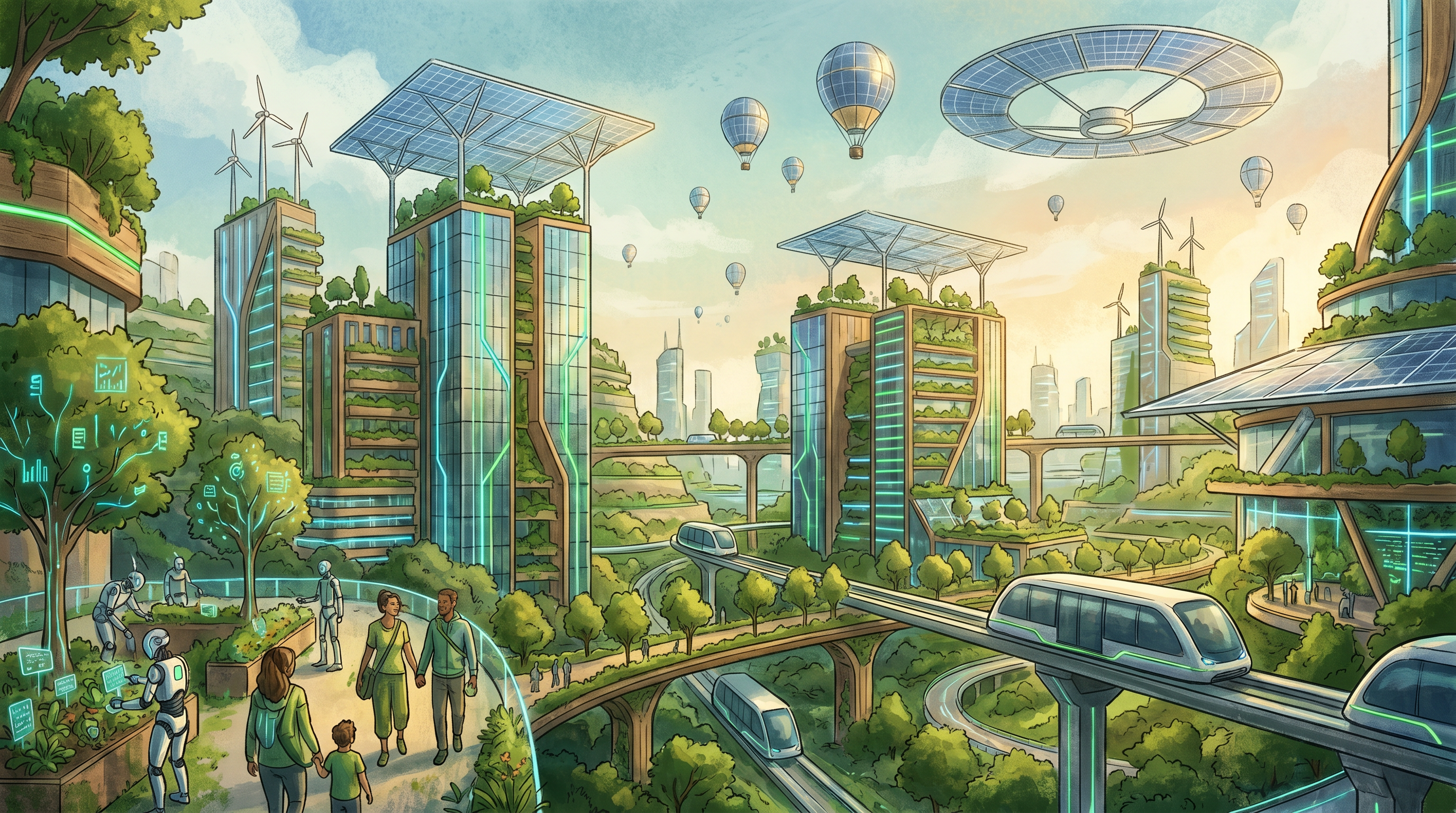
Sustainable smart city with solar energy
Frequently Asked Questions
How long do portable power stations last?
With proper care, quality units last 5-10 years. Battery chemistry affects lifespan—LiFePO4 batteries typically retain 80% capacity after 3,000 cycles, while lithium-ion batteries may reach that threshold at 500-800 cycles.
Can I use portable power stations indoors?
Yes. Unlike gas generators, portable power stations produce zero emissions and zero noise, making them safe for indoor use during power outages or in apartments.
What can a 1000Wh power station run?
A 1000Wh station can typically power a full-size refrigerator for 12-16 hours, a laptop for 12-15 charges, a 40" LED TV for 8-10 hours, or a CPAP machine for 3-4 nights.
How fast can solar panels charge a portable power station?
Charging speed depends on panel wattage, sunlight intensity, and station capacity. A 200W panel in optimal conditions can fully charge a 1000Wh station in 5-6 hours. Adding a second 200W panel cuts this to 2.5-3 hours.
Can I connect different solar panel brands?
Generally yes, using appropriate adapters. However, mixing panels of different voltages or wattages may reduce overall efficiency. For best results, use panels with similar specifications.
Are portable power stations allowed on airplanes?
Most airlines prohibit batteries exceeding 100Wh in carry-on luggage. Check with your carrier, but plan to use alternative transportation for larger units.
Conclusion: The Journey Continues
Portable solar power represents more than convenience—it embodies a fundamental shift toward energy independence, environmental responsibility, and resilience in an uncertain world. Whether you're a weekend camper seeking creature comforts, a remote worker demanding reliable power, or a homeowner preparing for emergencies, portable solar solutions offer compelling advantages over traditional fossil fuel alternatives.
Key takeaways from this guide:
- Portable power stations store energy efficiently for use anywhere, anytime
- Solar panels provide renewable recharging that works globally
- Capacity and wattage requirements depend entirely on your specific needs
- LiFePO4 chemistry offers superior longevity for frequent users
- Maintenance is minimal—regular use and proper storage extend lifespan
- The industry is rapidly innovating with better batteries, smarter systems, and improved sustainability
Ready to begin your sustainable energy journey? Evaluate your power needs honestly, start with equipment that meets current requirements while allowing growth, and invest in quality components from reputable manufacturers.
The transition to portable solar power isn't just about the equipment—it's about joining a global community committed to cleaner energy, greater independence, and a more sustainable future. The journey continues, and it starts with a single panel.
Browse our portable power stations and solar panels to find the perfect solution for your adventures and emergency preparedness needs.